
Budgets 2026: deckchairs on the Titanic?
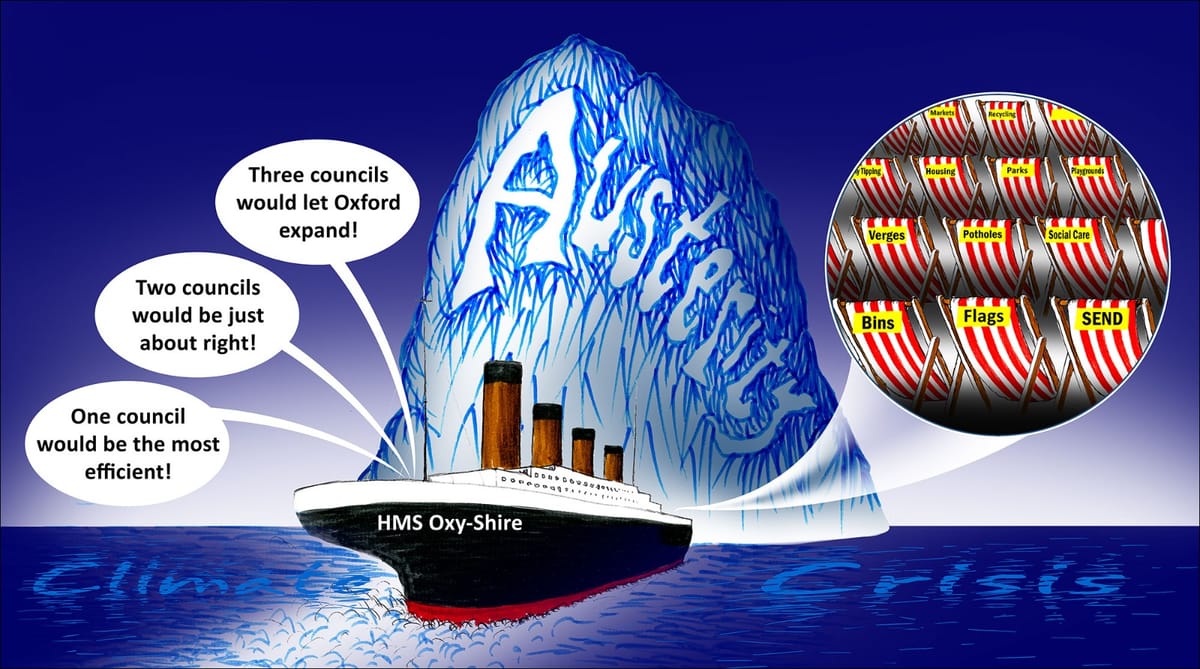
Oxfordshire’s councils’ days might be numbered – but the cheques still have to be signed, bills paid, and council tax collected.
As connoisseurs of Clarion cheese will know, the county, city and district councils are all set to be replaced by ‘unitary’ councils of as yet undetermined shape. So although drawing up a budget is the most important thing a council does each year, 2026’s process is a bit “shifting deckchairs on the Titanic”. Dramatic (i.e. multi-year) changes would be inappropriate when literally no one knows what the future will bring (thoughts and prayers go to all the officers reading this).
Yet the new councils won’t be in place until 2028; the deckchairs need to be kept in good order until then. That isn’t an easy job. Every year, expectations of councils get bigger while funding (particularly from central Government) gets smaller. That’s especially true here in southern England, whose Government grants are being cut to direct more money to the North. Meanwhile, the FT reported recently that nearly 70 English councils face insolvency due to the financial challenge of special educational needs (SEND) provision. Speaking of ticking time-bombs, all Oxfordshire’s councils have declared a climate emergency – and the time for prevaricating is running out fast.
So while we, as local residents, cast a critical eye over these proposals, we mean it when we say we take our hats off to the politicians and officers attempting to square an ever increasing circle. At least we're not in Warwickshire, where Reform UK have entrusted a 19 year old with the job of council leader…
Who does what?
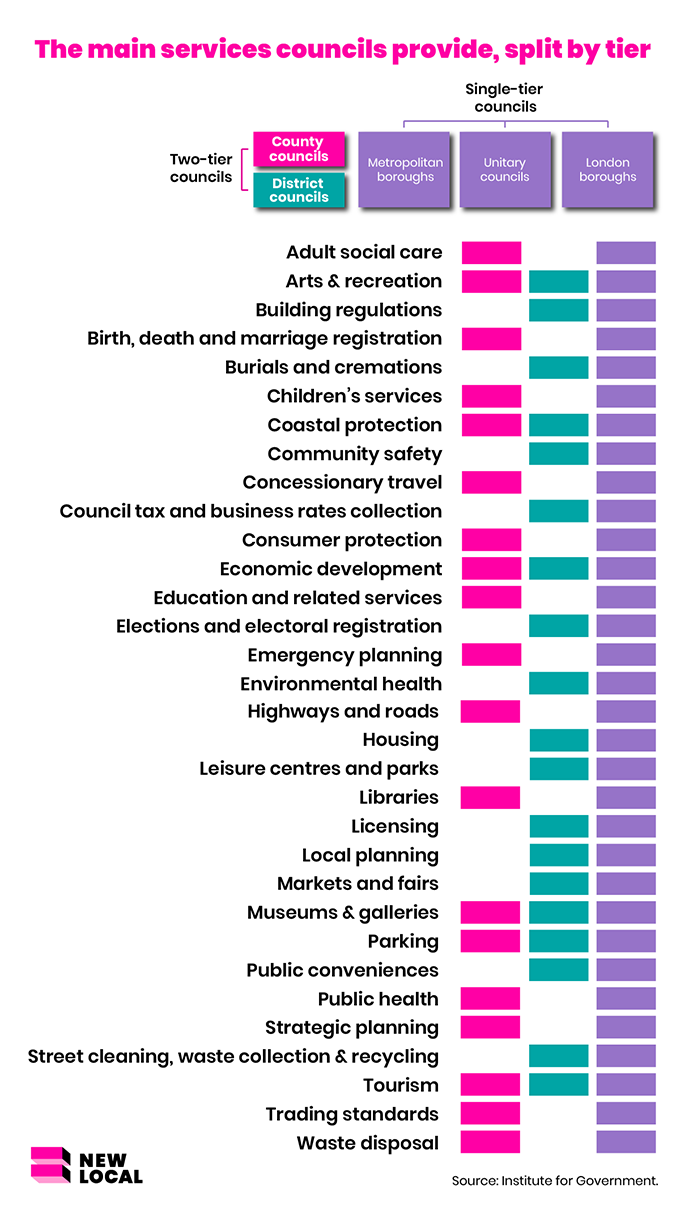
If you are a regular Clarion reader, you will have experienced our ire when council motions deal with matters for which that council isn’t actually responsible. To summarise: the bulk of County Council spend is adult social care and highways, but they also cover children’s services (including SEND), economic development, Trading Standards and libraries. The district councils, which include Oxford City, major on housing, by providing it themselves and judging planning applications. They also cover parks, leisure centres, licensing, public toilets.
The confusion between what different councils do, and the need to maintain two discrete sets of officers is much of what is driving local government re-organisation. Below is a handy diagram. All of this is to say: do not expect commentary on potholes in the city or district councils' budgets.
Oxfordshire County Council’s budget
£567,372,273.74. That is how much money Oxfordshire County Council will take from council tax payers this year, aka the “precept”. Add Government grant and other income, and the County Council is, quite literally, a billion-pound business.
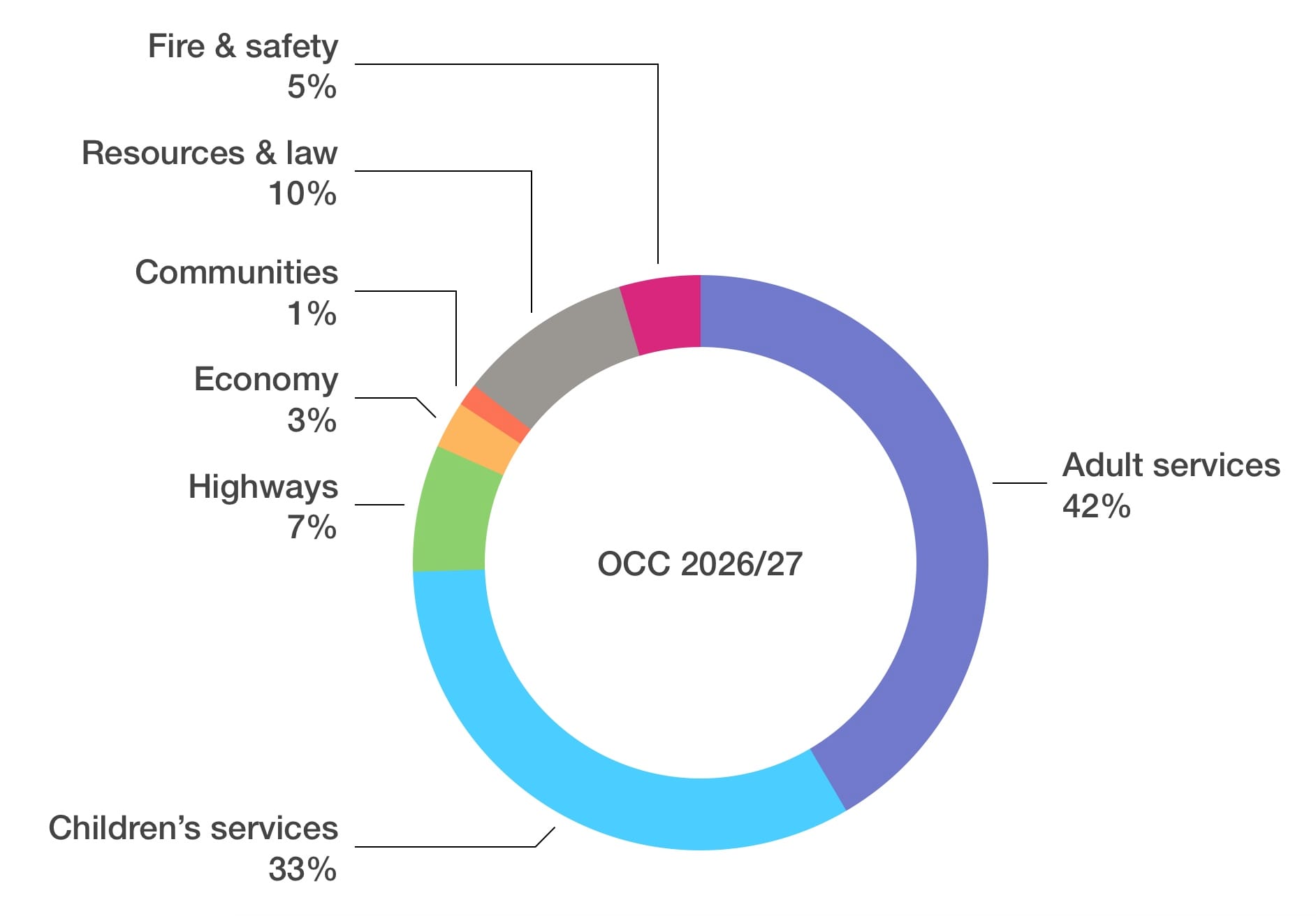
Where does it all go? Number one, adult social care. Number two, children’s services – principally special educational needs. Everything else is small change in comparison. Although the Clarion was put on God’s good earth to explain, not to condescend, our thoughts when we see yet another Facebook comment about “why are the potholes not fixed when I pay even more council tax?” increasingly tend towards “oh, my sweet summer child”. In the words of one councillor, Nathan Ley, “councils are becoming social care services with a few diminishing extras”.
The sums are mind-boggling. Next year, Oxfordshire will spend £98m on Special Educational Needs alone – some from Government grant, some from its own coffers. A further £112m goes on home-to-school transport. Demand is accelerating so fast that OCC expects its school transport bill for SEND kids to go up by £3.2m this year alone – and that’s before a penny is spent on actually educating them. OCC is proud of its record on adult social care, branded the Oxfordshire Way, but that doesn’t make it cheap.
With such big-ticket items non-negotiable, does that mean the county budget is merely tinkering around the edges? Not quite. With a £1bn budget, there’s always some room for manoeuvre.
This year, the Liberal Democrat-run County Council is increasing its annual support for low-income families by £3.2m. It’s spending £3.2m on clearing gullies to alleviate flooding. Woodeaton Manor Special School will be relocated at a cost of £2.6m. In transport, £1.7m goes on local cycling and walking improvements, £1.6m on HGV routes, and £250,000 on Quiet Lanes in rural areas – redesigning the smallest roads for walkers, cyclists and horse-riders.
OCC isn’t greatly impressed by its Government grant, either the level of it (“the government has chosen to reduce funding for councils such as ours and rely on local residents to make up for this”) or the timing, with the figures confirmed just a few days before Christmas. Oxfordshire’s LibDem MPs issued a statement saying that “the council is being forced to make extraordinarily difficult decisions because of the choice made by the government to cut funding for Oxfordshire”.
The amendments
Part of the fun of budget day is the amendments brought by the other parties. Sometimes these are carefully thought out visions for a better Oxfordshire. Other times, let’s be honest, they are little more than leaflet fodder.
This year, they are all, in effect if not in conception, fantasy politics. In the last four-year council, no one party had a majority, which meant horse-trading (both public and private) to find a budget which would secure more than half the votes. Now the LibDems are sitting on a comfortable majority, they can pass their budget unaltered. But although the amendments might not be passed, they have all been diligently reviewed by OCC officers, seeking to ensure that whatever gets agreed – however unlikely that might be – will meet the council’s legal obligations.
Labour’s amendments are serious, grown-up politics. They major on the Marmot Principles of tackling the root causes of inequalities. There would be £8.6m more for early intervention work in children’s social care, much of this paid for by trimming the council’s senior management. As the beleaguered Labour Prime Minister could ruefully testify, proposing big spending is easy in opposition, rather more difficult to carry out in power. But Oxfordshire Labour are at least making a principled case for the county they want to see.
(Our one quibble is that their leader Cllr Liz Brighouse writes “Many of the increasing number of young white males who have some of the lowest educational attainment in this county could be a Picasso or an Andrew Lloyd Webber if they had been exposed to Art or Music.” The Clarion is really not convinced we needed one Andrew Lloyd Webber, let alone more of them.)
The Conservatives’ amendments are… less high-brow? One proposal, for the pocket change sum of £50,000, is “the ability to apply for funding to cover costs for the provision of flags or banners on suitable highway street light columns through a county council approved supplier”. This might be kindly described as “provocative”, less kindly as “trolling”. There is £1.3m more per year for potholes, partly funded by “a scaling back of the carbon action team”. This is pure populism and will play well with many voters, but most Clarion readers will probably agree it’s a case of opening the stable door and inviting the horse to bolt. Nonetheless, the £200,000 for Fire Cadets to “strengthen long-term resilience and help reduce the likelihood that future proposals to close fire stations will be considered necessary” is both a remarkably astute piece of politics and a good idea in itself.
The Greens, unsurprisingly, are not proposing to scale back the carbon action team. Their flagship proposal was to cancel the Watlington Relief Road, which they say is costing over £8,000 per Watlington resident – “the funding would be better spent on projects to improve adaptation to climate change”. Of the £14m saved, £11m would have gone into cycling and walking schemes. We say this was their flagship proposal: as we go to press, we understand the party has withdrawn it in an attempt to make the rest of their amendments more likely to be voted through.
Because for each party’s set of amendments, there’s at least one reason why you can’t see the governing party nodding it through (Labour’s increased spending, the Greens’ opposition to the Watlington Relief Road, and, well, pretty much everything in the Conservative amendment). In some ways this is a shame: there are good ideas in each of the amendments. On the other hand, we’re glad we don’t have to sit through a separate debate for every individual proposal.
Oxford City Council’s budget
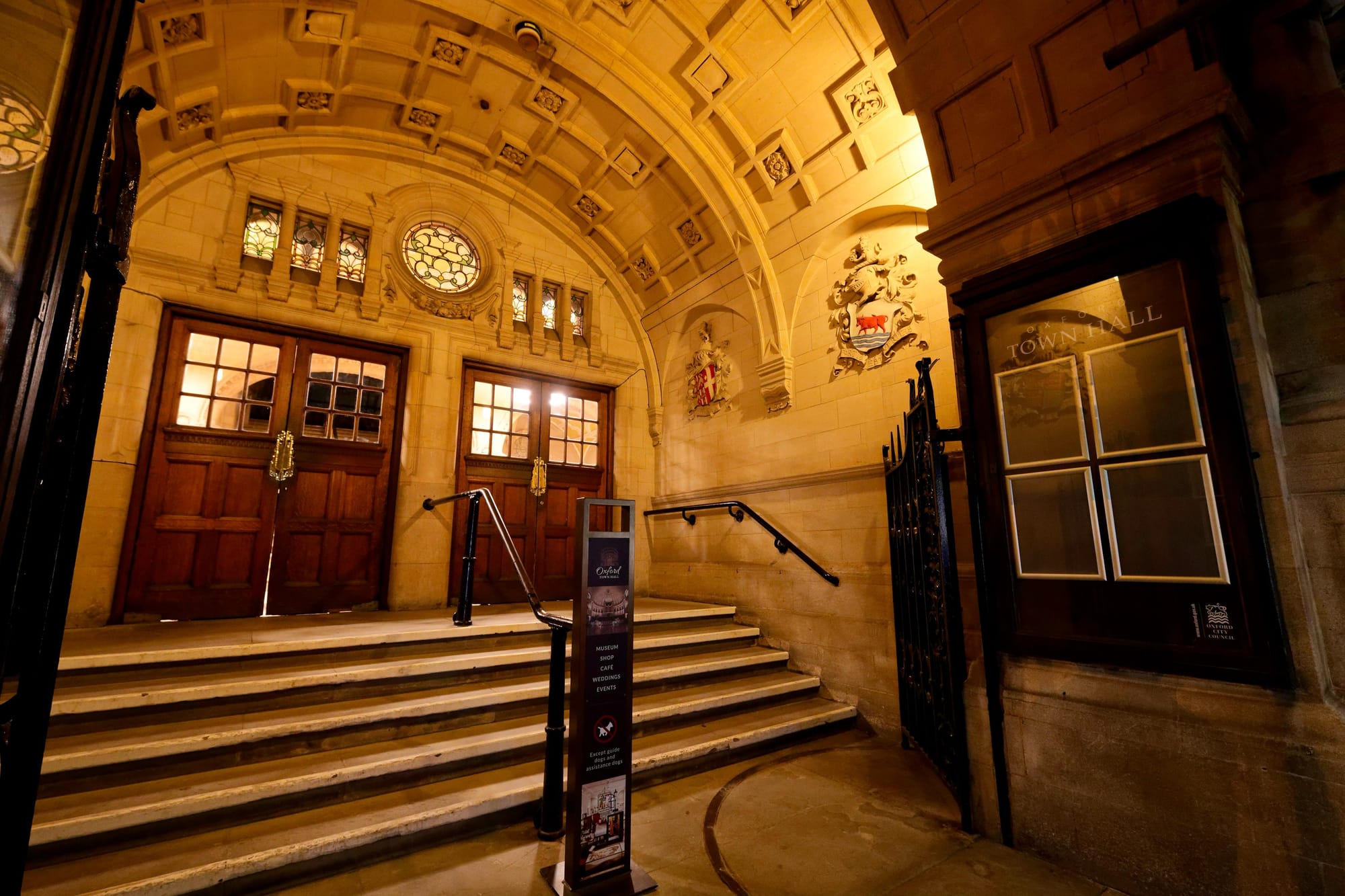
Budgets do not always make for interesting reading. But for the 165,000 people living in Oxford City, this is how the council will spend around £110m and materially impact your life for the next year. If you pay rent or a mortgage, visit a pub, or the Covered Market, a park or community centre, this matters. (The city does not look after the Botley Road, or the works going on at the station: that hot mess is Network Rail with a guest appearance from your friends and mine, Thames Water.)
Funds from central government (Labour, of course) constitute a real terms cut in council funds, even assuming the maximum permitted council tax increase. Not easy when everyone demands more from their council.
The council has built the budget, consulted on it (there were 358 responses – were you one of them?) and had it challenged by a cross party (Lab, Green, LibDem, IOA) Scrutiny Committee. Here's their report, which will be presented to Cabinet and Full Council on 11 and 23 February respectively.
The City Council claim the budget, in an extremely uncertain time, is modest and sensible, avoiding dramatic changes ahead of the local government reorganisation. Consequently the public signposting around most of the budget – both in the budget report, and from the budget scrutiny committee – appears to be almost trivial, even if individual items are no doubt of crucial interest to certain groups (gritting cycle paths, cutting grass). Here are the highlights in decreasing order of magnitude.
- 2.99% council tax increase – the maximum allowed
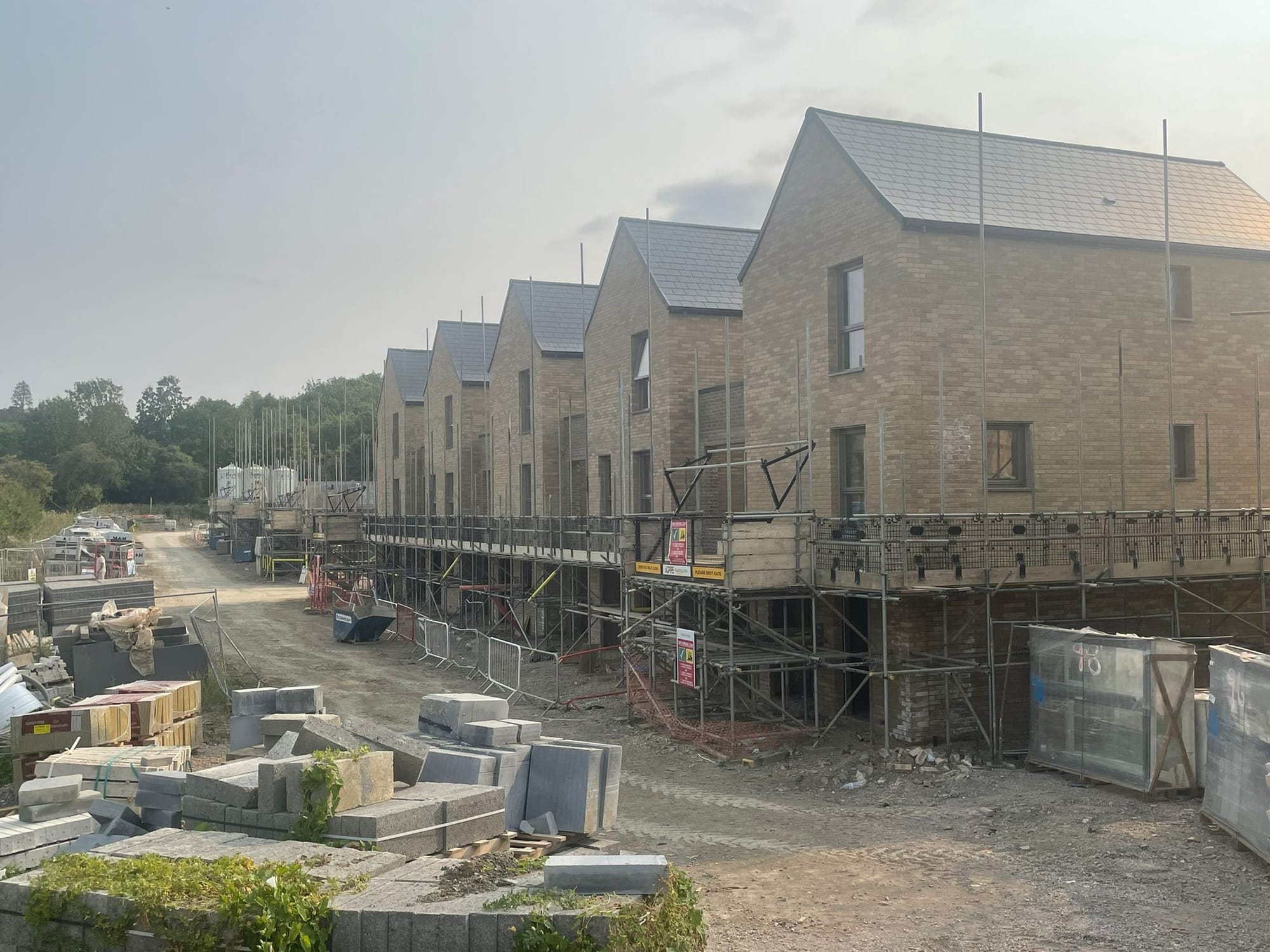
- Funding for 1,692 new council homes is be made available, as well as £32m to help purchase 260 properties to be used as temporary accommodation, to offset ongoing cost pressure on temporary accommodation.
- £3m capital investment to maintain waterways, including rivers, tributaries, culverts and ditches as well as around 60 bridges
- Car parking income is down £250,000 per annum thanks to the congestion charge reducing car travel in to the city. Car parking charges increase disproportionately – more for short stays of under 2 hours, not so much for longer stays of 6-8 hours. St Clements gets a swingeing 18.52% increase if you want to park there for under an hour.
- Three Neighbourhood Wardens to deal with anti-social behaviour: £120,000 per annum.
- Removal of the bulky waste collection charge, to combat fly tipping: £102,000 per annum.
- Gritting of cycle paths: £60,000.
- £30,000 support for Blackbird Leys Adventure Playground (on top of the huge sums currently being invested in Blackbird Leys as part of a regeneration project). There is nothing named for Northfield Brook, Minchery Farm, or central Rose Hill, some of the city’s most deprived neigbourhoods.
- Public realm: an additional £30,000 per annum to maintain furniture, flower beds and other infrastructure in the city centre.
- Verge cutting: £30,000 per annum to cut verges once more each year.
- Live music events support: £20,000 “to enable the City Council to support live music events”. (We are intrigued!)
- Picnic tables in the Wolvercote bathing area: £7,000.
See what we mean by trivial? Some nice things, that will make for compelling leaflets come May election, but ultimately a safe budget given the change the city is facing.
The Budget Scrutiny Committee's report focuses on even smaller matters. Perhaps that is because the budget was robust, and in scrutinising, the committee found little to amend? You decide. They made nine recommendations:
- Freeze the garden waste collection concessionary rate.
- The cancellation form for garden waste collection and other paid Council services should include tick-boxes asking about reasons for discontinuing the service, to enable the council to understand reasons behind the decline in use.
- Assess the cost of offering discounted compost bins.
- For houses in multiple occupation, licence fees should incorporate a levy to cover end-of-tenancy bulky waste disposal (by which we presume they mean the mattress mountains that appear in parts of Oxford at tenancy changeover times).
- Co-ordinate the gritting of cycle paths with neighbouring districts, to reduce costs.
- Offering a free hot drink at the Museum of Oxford Cafe with entry to the Museum of Oxford, to make entry more attractive.
- Introduce a long-stay (1-2 weeks) parking option at Park & Rides, to encourage tourists to park outside the city centre.
- Postpone closure of the Oxpens and/or Worcester Street car parks for one year to preserve car parking revenue, unless development is imminent.
- £20,000 to support voluntary groups maintaining town twinning links, in lieu of an officer.
Political context is important. Oxford City Council is Labour-run with their 21 councillors governing in a minority. The Liberal Democrats have 9, and the Greens another 9, with the remaining 11 seats divided between four groups of independents. The Oxford Independent Alliance are the anti-Low Traffic Neighbourhood party with 4 councillors. The Oxford Community Independents (formerly the Oxford Socialist Independents) and the Oxford Independent Group, with 1 and 2 councillor respectively, broke away from Labour in 2024 year over its Gaza policy. The Real Independents are 2 councillors representing Temple Cowley. (We have run out of Monty Python jokes.)
Team Labour do not have the votes to get swingeing changes through, even if it were responsible to do so ahead of the looming reorganisation. This therefore is a budget of consensus, scrutinised, proposed. We have not yet seen the proposed amendments, but given the fragmented nature of the council, no one opposition party has the votes to get anything dramatic though either.
It’s not for us to call how the votes will go in a hung council, but an entirely plausible outcome would see LibDems and Greens proposing minor amendments, perhaps totalling no more than £500,000 per annum; there will be a debate; Labour will make some concessions to get the budget through; and everyone will have a nice ‘we won’ story to put on their leaflets for May.
Does it address this city's giant housing crisis? In part. Does it address the city's waste mountain? In part. Does it, as the November 2024 motion resolved, make Oxford a more walkable city? A bit, but only when it's icy. Does it address the climate emergency? Not at all. We guess that is the point of a unitary – to connect (literally) housing with roads, local centres, and the infrastructure that makes a city.
(Since we first posted this article, the opposition parties’ amendments have been published – scroll down to see them.)
The districts
Ploughing through the documents for county and city budgets is gruelling enough for your volunteer Clarion correspondents, so you will forgive us for only skimming over the four rural districts.
Cherwell is planning to invest in more temporary accommodation, reduce green bin collections to every three weeks, and is no longer intending to remove Banbury Museum’s grant. West Oxfordshire, too, is buying more temporary accommodation; it’s also ordering a footfall monitoring system for Witney, Carterton and Chipping Norton. South Oxfordshire is funding community cohesion work and will introduce a new Climate Action Fund. Vale of White Horse is upgrading its leisure centres and resurfacing a BMX track. (All four councils have the LibDems as the largest party, in coalition with the Greens in Cherwell, and with the Greens and Labour in West Oxfordshire.)
The final balance
“Deckchairs on the Titanic” could not be more apt. Except there is not one iceberg, but at least three. Austerity – that is, declining Government funding – is one iceberg. Adult social care is another. Special educational needs is a third.
We do love writing about council reorganisation through the metaphor of cheese. But the numbers in this article make us wonder whether Government is focusing on the right problem. Given that 42% of our County Council’s budget goes on adult social care, would it not make more sense to tackle that first, through the establishment of Labour’s promised National Care Service? Why spend so much time agonising over the fate of the comparative minnows that are city and district councils, while the £34.5bn cost of social care is left to mushroom, pending a review whose recommendations might never be implemented?
Greater minds than ours can decide on that – and by doing so, those same minds are setting the course for HMS Oxfordshire.
Postscript: City amendments
(First published in our 20 February newsletter.)
The opposition parties’ amendments to the City Council have now been finalised. Since no single party has a majority, it’s likely that at least some parts of these will find favour. Here’s the highlights:
- The city LibDems say their amendments trim back on “nice-to-have giveaways”, principally on waste collection charges, community sports and twin towns. They propose employing two new housing officers, one to help people in temporary accommodation find homes, and another to improve enforcement of rental property standards. They would reinstate free entry to the Museum of Oxford during summer holidays; renovate public toilets and community noticeboards; put £50,000 of developer funding to a Summertown community space; and launch a project to revive public green space, and another to improve National Cycle Network routes within the city.
- The Greens would also reduce subsidy on waste collection charges and choose not to employ two new neighbourhood wardens. They would spend the savings on parks and green space, noticeboards, and community grants. (We can sense a majority coming together on some of these…)
- The Independent Oxford Alliance’s savings would also be on neighbourhood wardens, twin towns and community sports. They would direct music funding specifically to the Cowley Road Carnival, improve the Littlemore Community Centre, and invest in youth centres.
- Independent councillor Hosnieh Djafari-Marbini proposes improving lighting in Gillians Park, Northfield Brook.
Further reading
- Oxford City Council budget consultation, including links to detailed budget spreadsheets
- Oxford City Council budget report, presented to Cabinet 11 Feb
- Oxford City Council scrutiny review
- Oxfordshire County Council budget documents (all 50 of them!)
- Oxfordshire County Council leader’s statement (LibDem)
- Oxfordshire County Council Labour Group statement
- Oxfordshire County Council Oxfordshire Alliance statement (Conservative + independent)
- Oxfordshire County Council Green Group statement
- Cherwell District Council press release
- West Oxfordshire District Council press release
- Vale of White Horse District Council press release
- South Oxfordshire District Council press release
- Cllr Nathan Ley on “The Adult Social Care Theory of Everything”