
Oxford’s trailblazing living wage

Today marks the first day of Oxford Living Wage Week, an annual event celebrating our city’s belief that everyone deserves a decent wage.
The Oxford Living Wage was launched in 2018 after a campaign began in 2017. A living wage represents the true cost of living; according to the Living Wage Foundation, over 490,000 people in the UK have received a pay rise thanks to their implementation.
Oxford, ever the trailblazer, is the only city outside of London to set its own Living Wage. Today there are over 180 Oxford Living Wage employers, supporting over 30,000 employees. We've teamed up with Oxford City Council to celebrate this week and the project itself.
But why?
Oxford is the second least affordable place to live in the UK, after Kensington & Chelsea. Oxford City Council sets out neatly why housing in Oxford is so unaffordable:
“Oxford is a small city with a longstanding shortage of suitable land for building homes. This is an issue stretching back to the rapid expansion of the motor industry and associated trades which began in the 1920s. Two rivers mean we have a large floodplain. We are also tightly constrained by a Green Belt which goes right up to our administrative boundaries. Our largest remaining development site is Barton Park, which will have 885 homes when completed in 2027.
“Scarcity and high demand help make Oxford among the least affordable places to live in the UK. Average house prices are more than 12 times household earnings and private rents are more than 50% higher than for England as a whole.”
The Oxford Needs Homes campaign has seen the City Council tackle the issue of affordable housing in a myriad of ways: buying homes on the open market to convert to modernising empty homes, building in small pockets of land, and wholesale home building programmes. The council has set up an entire division, OX Place, to progress affordable homes at pace. Critics will argue that more could be done, but it is unarguable that quite a lot already is.
But increasing the stock of affordable housing is only half the equation. If you are a Clarion reader, or have been around in the city for any length of time, you will not need to be told that Oxford is one of the most unequal places in the UK to live. Parts of Headington, Walton Manor, North Oxford and Summertown are among the least deprived in England and over the last 10 years, they have become even less so. To the east, the Leys and Northfield Brook mark the most deprived parts of the city and significant efforts are ongoing to redevelop Blackbird Leys, together with other projects elsewhere in the city. Self-evidently, addressing the disparity between wages and housing costs means both improving housing costs (via availability) and wages.
Trailblazers
In 2017, a cross-party campaign group including the city's two MPs, leaders of Labour, Liberal Democrat and Green groups on both City and County councils, and unions wrote an open letter kicking off the campaign for a 'Real Living Wage'. The baton was then passed to the City Council's economic development team who launched the scheme in 2019, setting the Oxford Living Wage at 95% of London's Living Wage, the first and only city in the UK to do so.

The scheme launched with 70 vanguard employers including Wave Staffing, an events staffing agency. Chris Jones, partner at Wave Staffing, said:
“Oxford is an expensive place to live and we saw the Oxford Living Wage as a key motivator for employment. It’s always been part of our business model.”
Wave Staffing builds its pay structure around the Oxford Living Wage, with four levels of pay calculated each year. For staff, the commitment is clear; for clients, it reinforces the company’s reputation as a trusted, responsible partner.
“Our clients perceive us as a good partner because we are an Oxford Living Wage employer and we treat our staff well. That translates into the delivery of a great service.”
From staff interviews to client reviews, Wave Staffing has found that being an Oxford Living Wage employer strengthens their reputation across Oxford’s hospitality and events ecosystem.
A growing force for good
These days over 180 employers have signed up to the scheme, meaning over 30,600 local people earn at least £13.16 per hour, rising to £14.06 in April. As you can see, the increase vs the minimum wage is significant.
Hourly Wage | Annual Wage | |
National Living Wage (minimum wage for over 21s) | £12.71 | £24,784.50 |
Oxford Living Wage | £14.06 (from April 2026) | £27,417 |
London Living Wage | £14.80 | £28,860 |
The list of supporters is surprisingly varied; it includes employers from colleges to community organisations. The Oxford Bus Company is an Oxford Living Wage Employer. 15 of the 39 Oxford Colleges, including Magdalen and Jesus, are living wage employers. So are independent retailers like Caper on Magdalen Road, Hoyles on the High, and Covered Market stalwarts like Gulp Fiction and Hamblin Bread. Distribution companies like Velocity Couriers and community organisations like Oxford City Farm and Oxford Mutual Aid are in it as well – and, of course, Oxford City Council leading the charge with its 700 employees.
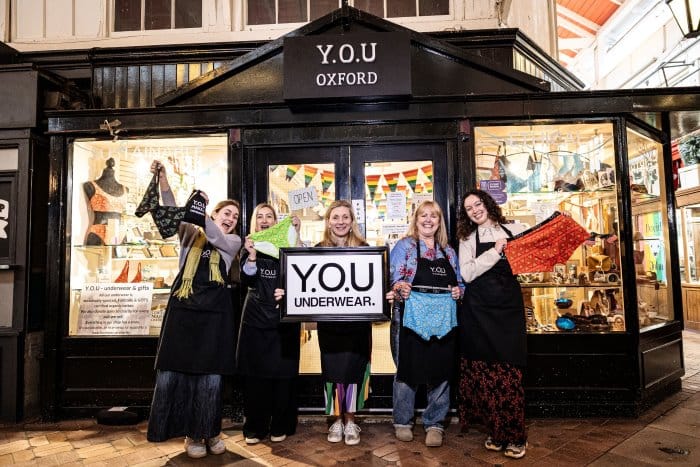
YOU Underwear has paid the Oxford Living Wage since opening. They describe it as not just a policy, but a core value for their business. As a B Corp and Social Enterprise, the ethical underwear brand knows how important fair pay is. Their founder Sarah Jordan explains:
“This was a decision that always made sense to me – from the very first person I employed to the small but growing team we have now. YOU Underwear was built to empower through underwear and that applies to our staff as well.”
Everyone at YOU Underwear earns the Oxford Living Wage, with pay rising as soon as new rates are announced. Transparency and equality are central to the company, and fair pay is seen as a key part of that.
“We know that paying the Oxford Living Wage makes our staff feel valued and contributes to strengthening team morale. As a result we have been able to attract good staff in a competitive job market meaning it benefits our business and leads to better growth.”
While the costs are higher, the benefits are clear: stronger morale, better retention, and a team that feels valued. Staff have shared how the Oxford Living Wage helps them cover essentials and save for bigger goals.
Sarah’s advice to other businesses?
“Do it! Committing to paying a living wage is a concrete demonstration that you stand by your business values and that you value the people working for you. You have the ability to contribute to a fairer world and your staff will thank you for it!”
The more, the merrier
This Oxford Living Wage Week, Oxford City Council is urging existing Living Wage businesses to re-accredit, encouraging new businesses to sign up. Councillor Chewe Mukonge is Oxford City Council's Cabinet Member for a Healthy, Fairer Oxford and Small Business Champion. He explains:
“Becoming an Oxford Living Wage employer is free and simple. You can fill out a short online form and we will guide you through the process. Employees can also help. A conversation with a manager or HR team about why the Oxford Living Wage matters can start real change, and our webpages include clear accreditation criteria and an easy application form.
“We all want a fairer and stronger Oxford. By paying the Oxford Living Wage, you are helping build it, one workplace at a time. This is a movement that benefits everyone.”
Oxford Living Wage employers. (Some Living Wage companies are based outside Oxford but operate within the city. A few companies have no geographical base so we have placed their pin at Carfax.)
We're in this together...
This venerable city of ours has been a centre of innovation for so many years. A trailblazing Covid vaccine; the pioneers of penicillin (don’t tell Alexander Fleming); the first (surviving) Park & Ride; the UK's first public museum; the mother of all dictionaries; the UK's first charity shop; the first coffee house in England; a global powerhouse in EV charging and storage.
Since 2018, it has also been an innovator on how it pays the people that support the very ecosystem of our city. The Oxford Living Wage depends on the employers that commit to supporting their employees in this way – but it's also down to citizens to support the businesses offering it. This Living Wage Week, we should celebrate not just the trailblazers who leaned in, but those who have joined along the way and those coming to the party right now.