Planning applications: there may be leopards

“It was on display in the bottom of a locked filing cabinet stuck in a disused lavatory with a sign on the door saying ‘Beware of the Leopard.’ ”
So Douglas Adams, writing in 1979, judged the opacity of English councils meeting the legal requirement to publish notice of planning applications. In 1990, probably by coincidence, the Town & Country Planning Act updated the requirement to include direct notification of particular stakeholders, and to allow for the public submission of comments on applications.
A letter through the door would alert affected neighbours to go down to the council offices, or perhaps the public library, to view the application. A small book was provided for handwritten comments, with commenters requested to note their name and address to confirm their interest (and to avoid misuse).
By 2005, nearly every English council had moved to an online system, operating under similar principles. Application documents are uploaded to a website, and a form provided for members of the public to submit comments, with name and address required. After a review, these comments are published alongside the document, to comply with the 1985 Access to Information Act.
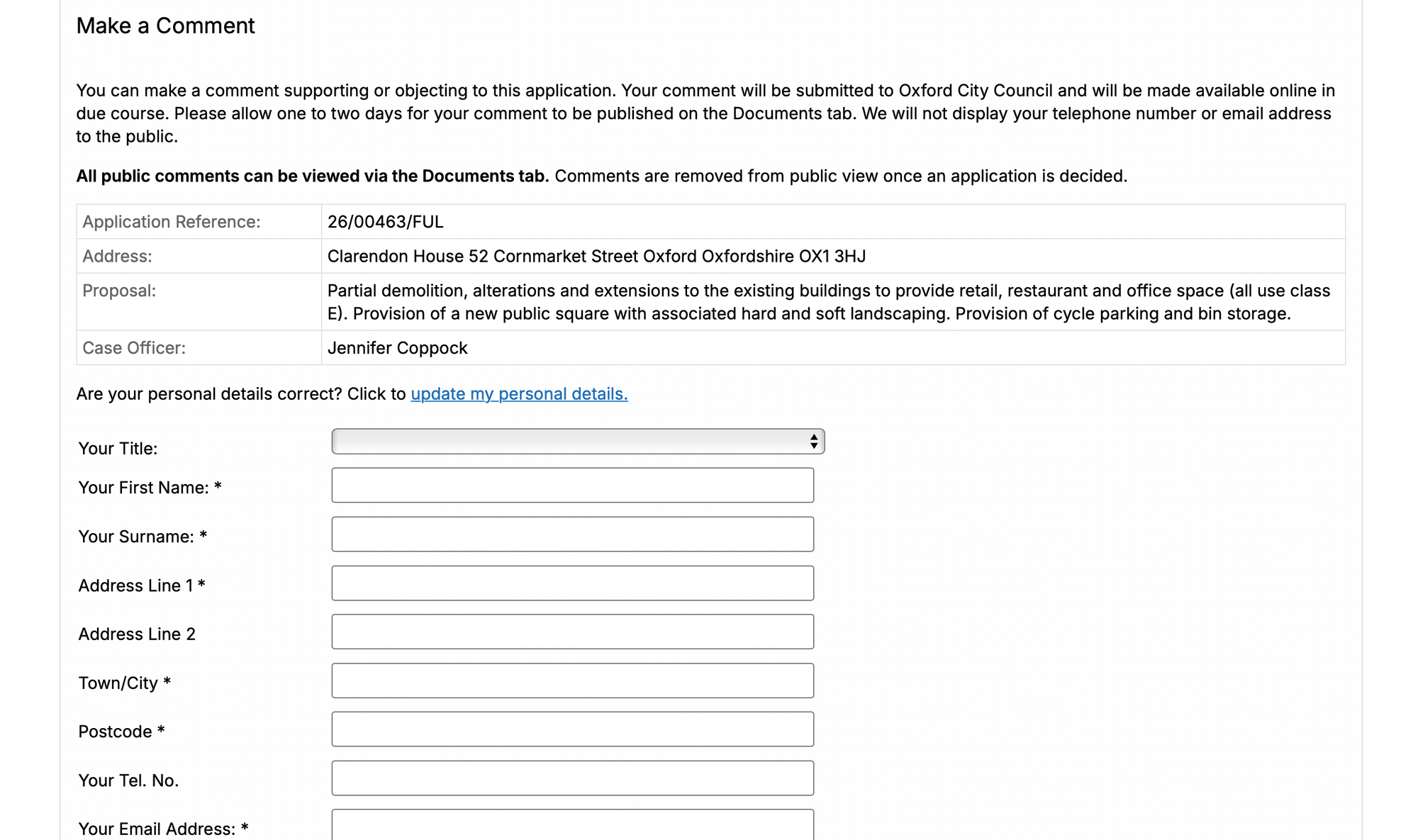
In 2026, this form now usually also requires a phone number and email address. These are redacted from the published version, in order to comply with GDPR regulations. However, Oxfordshire’s city and district councils still publish commenters' names and addresses in full, together. This is a dangerous holdover in the modern internet era, and prevents some people from engaging with the consultation process.
The modern internet is notoriously uncontrolled. Any information, once publicly online, is nearly impossible to remove. A name and address, published on a highly trusted council website, will be trawled by search engines, LLM (AI) bots, and archive machines. The council may remove the data from their page after the consultation closes, but they cannot remove it from the internet. (In researching this article, we successfully used all three of these to pull addresses from Cherwell and Oxford planning application comments.)
And many people have very strong reasons to not want their home address listed on the internet. The Office for National Statistics estimates that nearly 8% of English and Welsh people over the age of 16 experienced domestic violence last year. The majority of those were victims of an ex-partner. The majority of victims are women and girls.
A quarter of domestic abuse victims are stalked by the perpetrator. The dangers of careless data management are well known, and there is established government precedent for restricting access to a person’s address. Every registered voter has the right to opt out of the open register, for example, restricting their name and address to people with a responsibility to guard it. There is certainly no legal mandate for a council to publish this information.
Whilst it’s sensible for the councils to collect names and addresses of commenters, it would also be sensible for them to redact this information from publication. A compromise might be to publish only the name, or only the address, to allow the applicant to understand the context of the comment. Our councils have a duty to applicants, but they also have a duty to stakeholders.
Oxfordshire’s planning authorities disagree. In a 2025 response passed to the Clarion, Oxford City Council’s planning manager wrote:
“We consider it important that the public can see who has commented on a planning application as it helps ensure that there is an open and transparent process and also gives weight to the representation. This is because knowing what neighbours think about a proposal, helps officers take into account all material considerations while at the same time providing the general public with confidence that an informed decision has been taken. The way in which we handle this data accords with the GDPR regulations. […]
“I am fully aware that the procedure for publishing addresses varies across councils, and whilst places like Bristol City Council or Oxfordshire County Council may take their own view, there are plenty of other authorities in the surrounding area and across the country that take the same approach as us.”
Yet most councillors themselves – including those on the planning committee – now withhold their own addresses out of (justified) concerns about abuse. Only six of Oxford’s 48 councillors publish their home address; most are listed as c/o the Town Hall. Most candidates for May’s elections have taken the same decision, being listed merely as “address in Oxford” apart from one poor unfortunate in Swindon.
The four rural district councils, too, publish commenters’ names and addresses. But when comments were invited on Oxford United’s new stadium, Cherwell District Council took the one-off decision to redact names and addresses. A spokesperson said:
“While the Oxford United planning application was under consultation we took additional steps to protect the privacy of those making representations. This was because of the heightened level of public interest surrounding the stadium plans, including submissions by under-18s."
Our democratic processes work best when everyone is afforded an equal opportunity to participate. The planning applications may no longer be in a locked filing cabinet, but we must still beware of leopards.