
Reasons to be Cheeseful, Part 3

Is Oxfordshire’s local government reorganisation all over bar the shouting? The Secret Cheesemonger looks into his crystal ball of Edam…
Predicting the near future is usually a losing game. Either you are right, and in retrospect everyone agreed with you and it was obvious all along, or you’re wrong, and never live it down.
That said, I think the increasing assumption in Oxfordshire that central government is about to announce the carve-up of local government in Oxfordshire and West Berkshire up into three smaller unitary authorities – a Greater Oxford, a Ridgeway Council in the south, and a North Oxfordshire grouping Cherwell and West Oxfordshire – may be misplaced. Possible? Yes. Likely? Perhaps. A racing certainty? No.
The evidence on which this belief is based seems, primarily, to be that the government has in the second tranche of reorganisation decisions (affecting mainly East Anglia and the South Coast) erred on the side of smaller authorities than their original announcement implied. The widespread impression, contested by the Ministry, is that it has done so in a way which is at least in part designed to protect a likelihood of local Labour rule in the denser urban unitaries being created, and that the same logic therefore applies to Greater Oxford.
We’ve already covered the economic and practical considerations. The difficulty of planning transport across split authorities; the connected nature of Oxfordshire’s economy, from Bicester to Oxford to Harwell; the worry that North Oxfordshire could become an unsustainable runt of the litter.
But what of the politics? Here are eight reasons why a three-way split might not be a done deal.
- The announcements on which people are basing this logic were a point in time. From one angle, they look like a course correction after criticism of the decision to create two, rather than three, unitary authorities in Surrey (population just over 1.2 million). The Government has claimed all along that each decision is an individual decision, not a precedent. Criticism of the latest announcements has been vociferous, so they may reverse course a second time.
- The political logic of protecting probably-Labour areas in East Anglia is protecting them from likely majority control by Reform – a logic backed up by the recent elections. Three unitaries for Oxfordshire, in contrast, would sacrifice Banbury and Witney to a meaningful risk of future Conservative/Reform rule, while leaving an expanded Oxford with a combined LibDem/Green majority for the foreseeable future. Higher risk, lower reward.
- The second tranche of announcements was made at a point when Keir Starmer was fighting for his survival against a Parliamentary revolt. By the time of the next wave of decisions, we will likely be in a Labour leadership contest. Buying the favour of MPs may be an issue for the candidates – but if Starmer is not one, the current government may return to more evidence-based, and less political, choices. Andy Burnham, don’t forget, was Mayor of Greater Manchester and as such has seen what larger, stronger authorities can do. Legacy, not partisanship, may prevail.
- The above two points have been thrown into sharp relief by the forcefulness of the response of Wave 2’s “losers”. Not only are they using the departure from the government’s stated criteria as the basis to seek judicial reviews, this has caused the release of advice to Ministers. That advice gives strength to the case that the decisions in Wave 2 were political ones, not choices made on expert impartial advice. Defending what has already been done may be within the energy of Whitehall, but putting up another target may not. The original stated criteria may make a comeback.
- There is growing concern that the “big bang” approach to creating new unitaries may simply not be sustainable if the choice is to create a large number of small unitaries across the landscape. There are not enough change managers, IT consultants, and all the myriad people who make a new unitary come into being safely, legally, and successfully, to get the job done all at once for over 60 new authorities if small unitaries are set up everywhere. Politics is the art of the possible.
- The authorities forming the new unitaries are in worse reputational shape than previously appeared. Yes, there are arguments that Cherwell District’s loss of planning powers relates to historic performance. Nonetheless, the Government right now deems them not fit to exercise these powers. Does it deem them fit to set up a new planning authority for North Oxfordshire, at the same time as standing up a new social care function? West Berkshire’s share of the Berkshire Pension Fund is more balanced than the whole, but the whole is in a challenging place despite recent strong stock markets, having only 86% of the required funding. Does West Berkshire bring across a healthy balance, leaving the rest of Berkshire in more dire straits; or does it sacrifice some of its share to bail out the rest of Berkshire, and join with a smaller dowry? Pensions are not the only area of financial challenge. Credibility and feasibility matter.
- The financial situation has worsened overall since the earlier announcements, not least thanks to the recent war, and the rise in Government borrowing costs. Creating three unitaries in Oxfordshire, even by the standards of the decisions made so far, would lead to two being at the smallest end of even the recent decisions. A pattern of large unitaries everywhere comes with a saving in the low £billions. A pattern of small unitaries with a net cost approaching £1bn. Even if politics does trump evidence, does a Labour leader want to spend £3bn more than necessary on administrative overheads and duplication in the South and the shires, when that money could be used on frontline services, on defence, or in Labour heartlands, many of which have been unitary since 1974? The “Fair Funding Review” suggests not. These decisions are not being made in a vacuum.
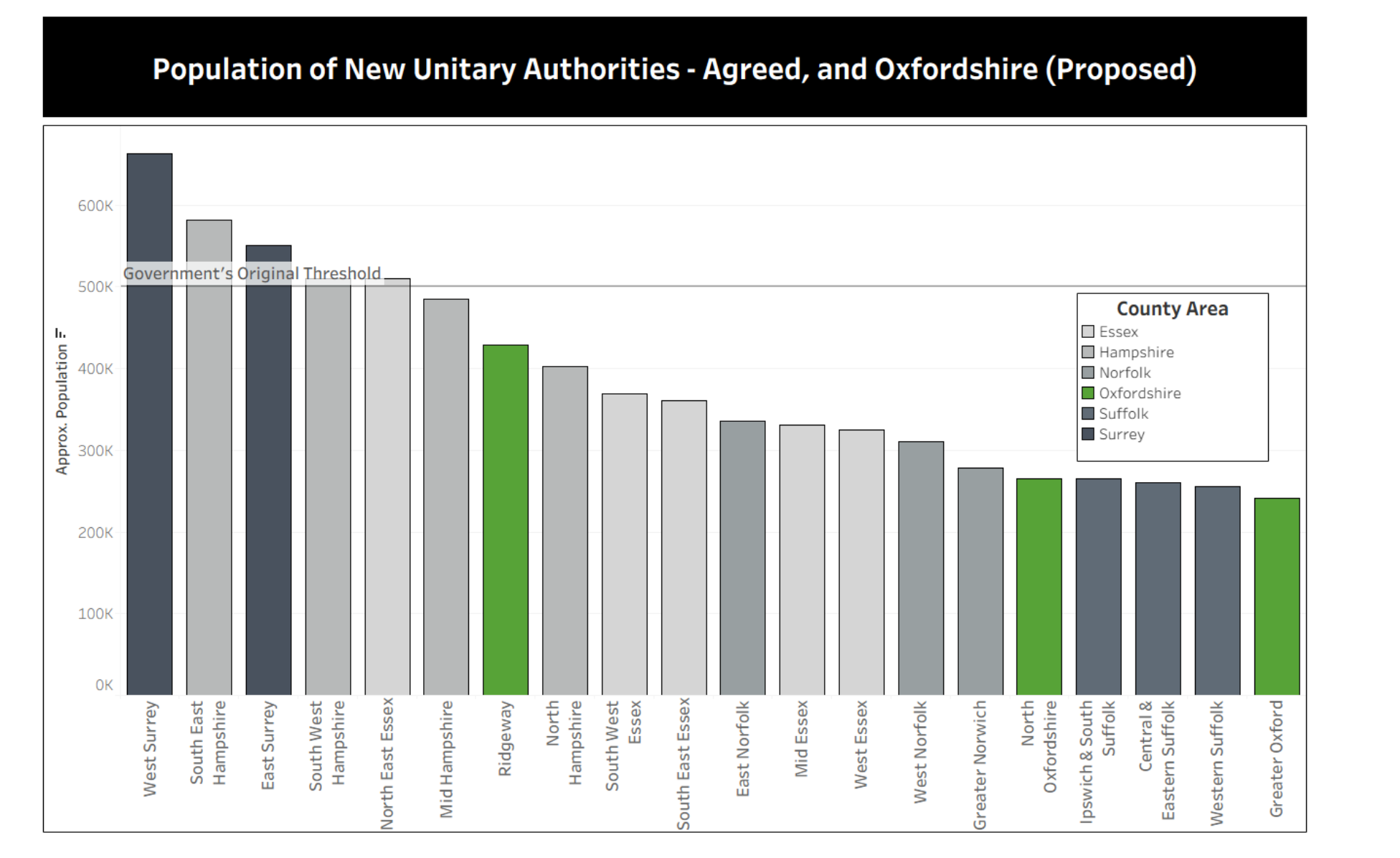
- Labour MPs, particularly in Oxford, cannot help but back the longstanding party line of “independence for Oxford”. But some may privately be careful what they wish for. Oxfordshire expects to lose £27.2m in central funding by the end of the decade. Facing an electorate currently projected to turn Green, do Labour really want to own the national ‘fair funding’ cuts to Oxford, with the new local government structure making it harder to protect the frontline? Even if Oxford Labour’s legendary electoral machine (and the curious exclusion of Abingdon) keeps Greater Oxford under some kind of Labour control, do they really want to own a series of painful decisions? Or is it better to fight the next general election as the local opposition standing up for Oxford against “county cuts”? To govern is to choose…
No single argument here is decisive. Taken as a whole, might they be an argument for the current PM, or a new Labour leader, to step back from the logic of the decisions made so far. Might they delay the decision; recalibrate in favour of a single unitary for Oxfordshire; or take the ‘Historic Oxfordshire and Thamesdown’ 2-unitary proposal featured in the Clarion in March off the shelf? They might.
The direction of travel is less settled than it appears. The case for anticipating a three-unitary outcome is plausible, but far from inevitable.