
Right town, wrong place?
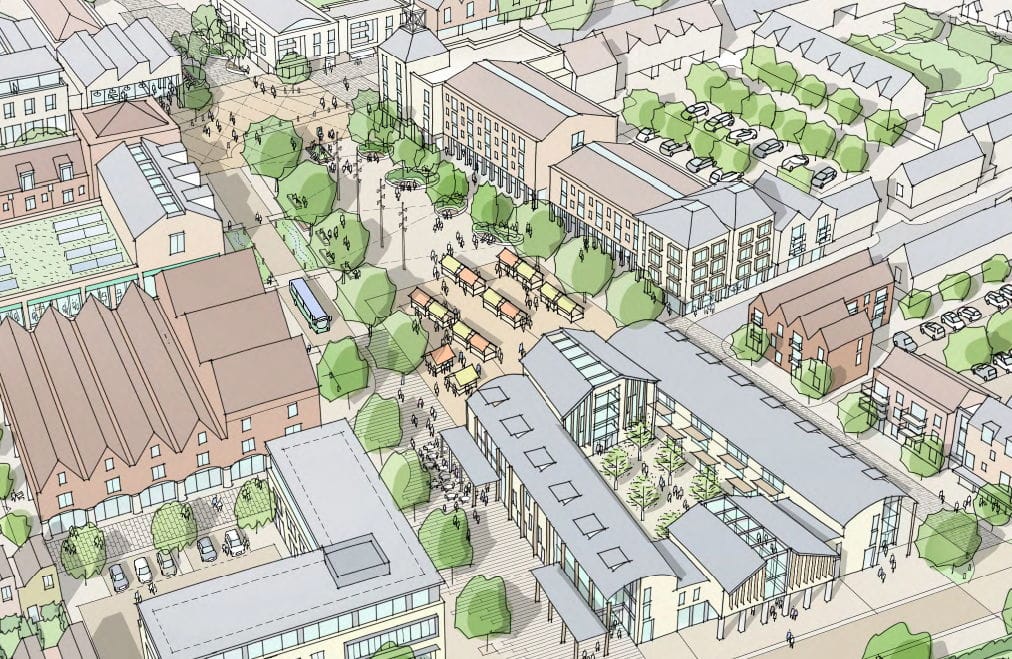
Outline plans have been unveiled for Chalgrove Airfield, Oxfordshire’s most controversial housing development. Can the merits of a “21st century sustainable market town” outweigh the problems of its location?
Chalgrove New Town would be located on one of Oxfordshire’s many historic airfields, ten miles south-east of Carfax. It is being promoted by the Government’s housing agency Homes England – and fiercely resisted by locals, South Oxfordshire District Council and transport campaigners.
Unlike the new towns at Heyford Park, Salt Cross, Culham, and Begbroke, Chalgrove is nowhere near any railway. Cycling to Oxford would be a stretch, and to Science Vale implausible. At first glance, it would be entirely car-dependent: indeed, its location five miles from the M40 might attract long-distance car commuters. The site is, arguably, unfixable.
Instead, Homes England stress that they can reduce the need to travel by building “a 21st century Oxfordshire market town” with shops, services and employment on site. It’s a seductive vision. But at first sight, the numbers don’t add up. The 3,400 homes imply some 8,000 residents. Homes England are promising 2,000 new jobs. Even after discounting WFHers, children and the retired, that’s thousands of residents who’ll need to travel to work every day.
Can the circle be squared?

Right town…
Today’s Chalgrove is a remarkably endearing village. Thatched cottages dot the high street. A little stream runs alongside, crossed by a tiny footbridge to every front door. Two free houses, the Crown and the Red Lion, face each other across the street; the Lamb is 700 yards away. There are medieval wall paintings on the church walls. It’s so classic an English village that, no word of a lie, an episode of Midsomer Murders was filmed at the timber-framed manor house.
For their 3,400-home extension, Homes England are unashamedly leaning into this Oxfordshire heritage. Crossing the road from today’s village, the future traveller will encounter a green lane, a village green, and a market square, the latter envisaged as “a central community hub including shops, cafes, restaurants and other facilities”.
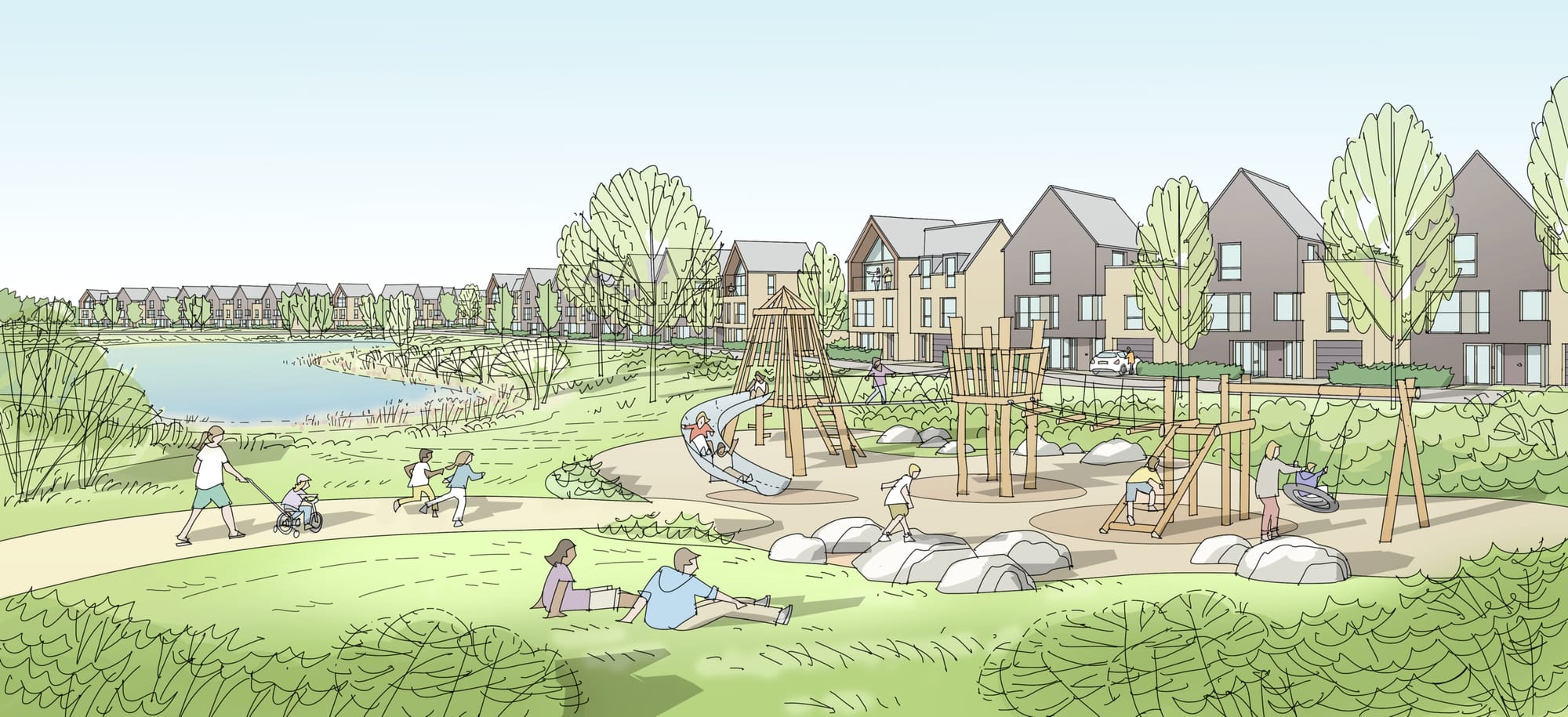
Houses will be a mix of designs, sizes and densities, rather than cookie-cutter estate homes. There will be a fourth pub, allotments, playing fields and a common. At a time when the county’s new architecture is either full-on international city or a peri-urban recreation of Central Milton Keynes, this willingness to learn from the best of Oxfordshire – on a site where the land take allows it – is refreshing.
The publicity material ticks all the right boxes. “Walkable neighbourhoods and a friendly community spirit.” “Community parklands, views of hills, church towers and manor houses.” “A continuous traffic-free south-north green link aligned with a historic connection from Chalgrove.” Neighbourhoods will have idyllic names like Rofford Park, Hampden East and (this one might be over-egging the pudding) Shakespeare’s Greenway.

Wrong place?
But even if the architecture were to win the Stirling Prize, the pub be crowned as CAMRA Pub of the Year, and the schools soar to Outstanding on their first inspection, Chalgrove Airfield is still hobbled by its location.
There is no railway station anywhere nearby. When the Cowley branch line reopens, Oxford Cowley station (where nothing more than a token car park is envisaged) will be eight miles along the B480. The nearest Park & Rides, at Redbridge and Thornhill, each require a journey along the busy and sometimes slow ring road.
The direct bus to Oxford takes one hour. Some heroic timetabling could perhaps get that down to 45 minutes each way, though since not everyone will be heading to the same destination, there is limited opportunity to reduce the number of stops in Oxford. Cycling is unlikely to be an option: Oxford city centre will be 11 miles away on roads that could only be made safe by an expensive segregated cycle track.
Other destinations fare little better. Culham is 9 miles from Chalgrove, Didcot is 13, Harwell 15. Chalgrove Airfield is admittedly convenient for the M40 – it’s five miles from junction 7. But given that Oxfordshire has enough housing pressures of its own, should it really be providing dormitory housing for commuters to West London and the lower Thames Valley?
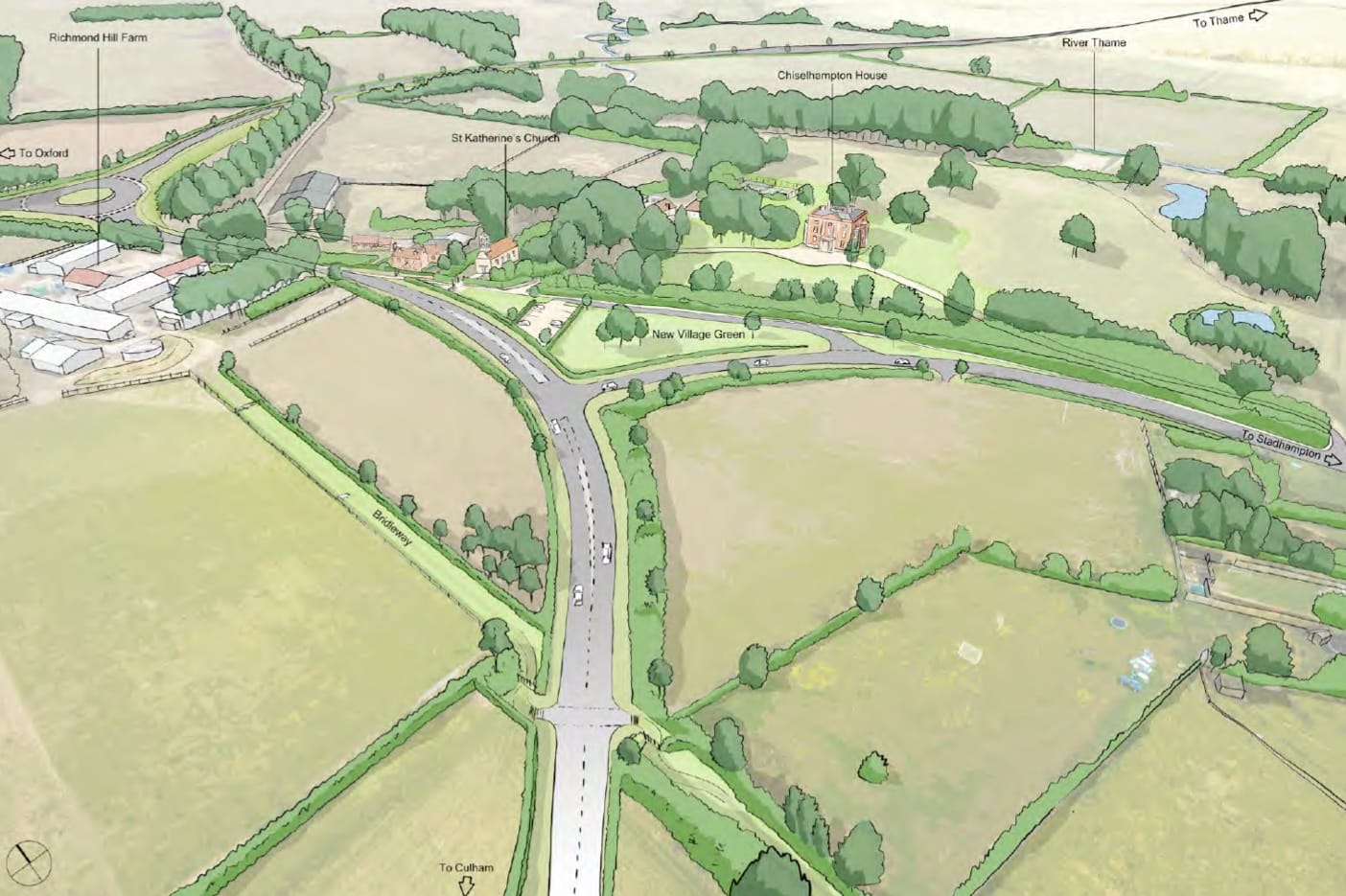
Homes England’s plans speak of “reducing the need to travel” and “encouraging a shift to getting around actively”. They promise improved bus services: up to four buses per hour to Oxford, two to Watlington, and one to Didcot.
They concede that “some road impacts are expected, [but] these are managed through targeted improvements, delivered only if needed”. Yet these improvements include a new bypass for Stadhampton and Chiselhampton (on the road to Oxford), unlikely to come in much below £20m. Homes England would not be proposing to spend £20m if it were not expecting a significant increase in traffic. Research backs this up: a recent paper argues that new towns often encourage both inbound and outbound long-distance commutes.
It’s hard to find an existing Oxfordshire town that is so poorly connected. Witney and Thame are both closer to railway stations. Wantage has the potential of one. Perhaps only the remote rural towns of Chipping Norton and Faringdon are car-dependent to the scale that Chalgrove Airfield would be.

We have lift-off
Since 1946, Chalgrove Airfield has been the testing facility for Martin-Baker, the world’s leading manufacturer of ejection seats. 93 airforces use their seats – including, of course, the RAF – and they claim a 54% global market share.
Chalgrove is neither Martin-Baker’s headquarters nor their research base; those are at Denham, in Buckinghamshire. It is not unthinkable that they could move their test facilities to another airfield if a tempting deal were offered.
But, publicly at least, they have no intention of doing so. Documents obtained from Homes England under FOI repeatedly report that Martin-Baker has been “unwilling to engage”. The ejection seat company has previously been backed up by the Civil Aviation Authority, whose objections dealt a hammer blow to earlier proposals. Politicians have also weighed in, with Henley & Thame MP Freddie van Mierlo saying “any disruption puts UK and global security at risk”.
Recognising they’re on a sticky wicket here, Homes England have revised their plans to include an entirely new aerodrome at the back of the site. It would have just one runway, vs the three at present, but with a similar length to the longest. They claim the operational area will be “similar to the current airfield size”, and that the new location will be better separated from residents. Martin-Baker have not yet commented.
At first sight, this might look like a mere financial dispute that could be solved by Homes England offering the right price. But the symbolism is more than that. If Chalgrove New Town is really offering jobs on-site, rather than a commuter-dependent island, annoying the one existing employer is a strange way to go about it.
Local councils and planning
The decision on whether to allow building at Chalgrove Airfield will ultimately be taken by the district council. That’s South Oxfordshire, currently Liberal Democrat-controlled with the Greens in second place.
The council's current Local Plan, the overarching planning document for the area, is unambiguous. “Land within the strategic allocation at Chalgrove Airfield will be developed to deliver approximately 3,000 new homes.” It lists all the facilities required: schools, healthcare, new buses.
Except South Oxfordshire District Council doesn't support the site.
Confused? The Local Plan was formally adopted in 2020, and remains in force either until 2035, or a successor document is agreed. But it was substantially drawn up by the previous Conservative administration, which was voted out in 2019 due to local concerns about development – particularly Chalgrove.
No sooner had the (then) LibDem/Green coalition got their feet under the desks than they tried to withdraw the plan. But Robert Jenrick, the Conservative housing secretary at the time, disagreed with the voters of South Oxfordshire. In March 2020, he ordered SODC to “progress the Plan through examination and adoption by December 2020”.
South Oxfordshire has since tried to withdraw the site once again. Its new draft Local Plan, drawn up jointly with Vale of White Horse, does not include a single mention of Chalgrove Airfield. But Whitehall has again intervened, this time in the shape of the Planning Inspectorate, which said the plan had failed on the “duty to co-operate” with neighbouring councils. Discussions continue (it's complicated), but for now, Chalgrove Airfield remains an approved site.
Oxfordshire County Council has maintained opposition to the development since day one. In 2018, it wrote: “Without major supporting infrastructure, it will be quite remote from the main local growth and activity centres it could potentially serve, and will lead to unsustainable impacts – most notably in highway and public transport terms”. Its position hasn’t changed.
Parish councils, local MP Freddie van Mierlo, CPRE, Oxfordshire Roads Action Alliance: all are equally opposed. Even Oxford City Council, which generally takes a gung-ho attitude to development in neighbouring districts, is unimpressed, preferring a site bordering the city at Grenoble Road. Its Greater Oxford ambition pointedly stops just a few metres short of Chalgrove Airfield, as if to say “nah, we’re not touching that”. Put simply, we haven’t found a single letterhead in Oxfordshire under which a letter supporting the plans might be written.
Go west?
There is some irony in that Homes England is currently working up another new town proposal with a similar journey time to central Oxford. Wychavon Town will have 10,000 homes, with direct trains to Oxford taking about an hour – more or less the same as the number 11 bus to Chalgrove. Except Wychavon is in distant Worcestershire, 60 miles north-west of Carfax and ideally positioned at the crossing of two railways.
Homes England is expected to file its planning application for Chalgrove Airfield “later this year”, with only a few weeks remaining in 2025. Separately, the Government is about to remove the Duty to Co-operate from Local Plans, clearing the way for South & Vale’s Chalgrove-free plan to be resubmitted. The scene is set for an almighty pile-up, almost certain to end up in an appeal landing on the desk of the Secretary of State.
The Clarion readership has a strong YIMBY contingent (“Yes, In My Back Yard”), and rightly so. Oxford needs more homes. Not all of those can, or will, be built in the city itself. Commuting is inevitable. But the fact that Wychavon will be just as well connected to Oxford, despite being 60 miles away, should give pause.
Even if 2,000 jobs are created on site, there will be little compelling reason for the tech employers who are driving Oxfordshire’s success to locate in Chalgrove when they could choose Culham or Harwell, Begbroke or Littlemore. The development is too small to be self-sufficient, too large to vanish unnoticed into the maw of Oxford’s transport demand.
It is hard to escape the conclusion that Chalgrove has been selected as a site merely because it’s brownfield land vaguely near Oxford. But we think even the most avid YIMBYs could find more suitable places in Oxfordshire to build 3,400 homes.
