
Traffic Filters vs Congestion Charge : Contest or Evolution?
The Oxford Traffic Filters switch on this morning, and we've just got used to the congestion charge. Oxfordshire Liveable Streets are a not-for-profit organisation working alongside residents across Oxfordshire to imagine and build streets and neighbourhoods that work better for everyone. Today we open the pages of the Clarion to Siobhann Mansel-Pleydell, Managing Director of Oxfordshire Liveable Streets, to take a deep dive into the change. This content originally appeared on Oxfordshire Liveable Streets.
And here we are. 1,258 days and £161 million later, Botley Road is finally open, and the Oxford Traffic Filters switch on today, Monday 28th September. The trial will last for about 18 months.
We're here to ask and unpack a question many of you might be asking yourselves too: which one will be better for Oxford and commuters, the Congestion Charge or the Traffic Filters?
Because we are here now in a unique position. The closure of Botley Road, as painful as it's been, brought forward another scheme, and in doing so, handed us a genuine opportunity: two different mechanisms, tackling the same problem, giving us the chance to compare. Though this does come with challenges, more on this later.
A reminder on sticks and carrots
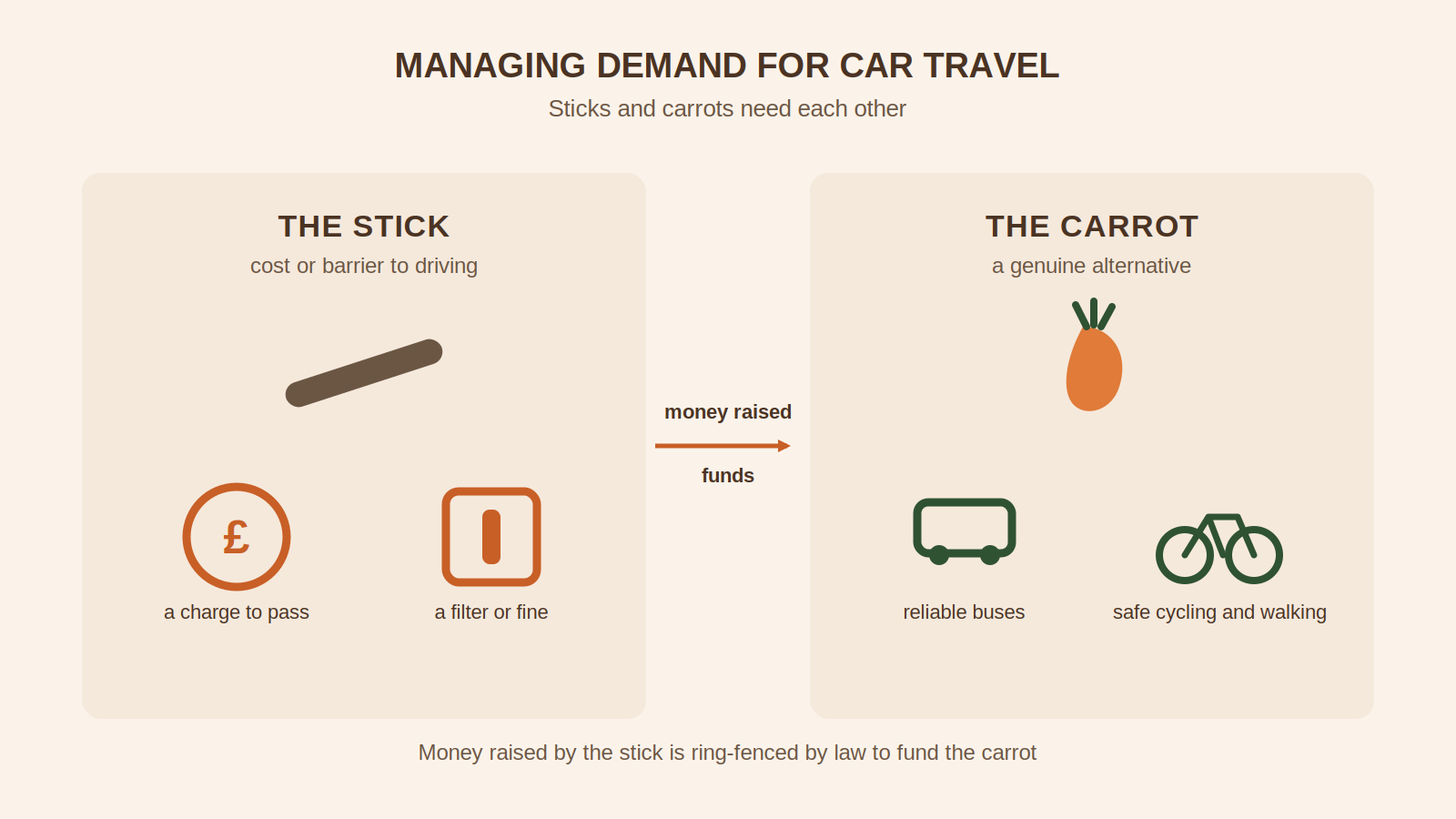
First, a brief reminder. Charging and filtering are both ways of managing demand for car travel, and both work as a mix of carrot and stick. The stick is the cost or a barrier to driving (charge or fine). The carrot is a genuine alternative: reliable buses, safe routes for walking, wheeling and cycling. On their own, sticks without carrots tend to just make life harder for people who have no other choice (Hensher & Puckett, 2007).
Hypothecation is what links the two. It means the money raised by the stick is ring-fenced to fund the carrot, rather than disappearing into general spending, and in the UK this isn't just good practice, it's a legal requirement. Surplus income (after implementation costs) from schemes like these can only be spent on specific things like transport improvements and environmental measures among them. It’s the same legislation that governs London's charging and enforcement regimes.
That legal underpinning is part of why hypothecation can help build public acceptance, especially when it's communicated well and people can see the benefit (it’s also the answer to the oft-heard ‘it’s just a cash-grab!’ criticism).
Two core things to hold in mind at this point: hypothecated charging, done well, not only reduces traffic, but enables modal shift through service and infrastructure reinvestment AND plays a distributive role to address transport poverty. Read more on our May blog for background here.
Framing the comparison
Clearly it's too early to do a like-for-like: the traffic filters have only just begun and we have no real-world data to set against the charge's ten months. What we can do is take stock before that data lands: what's the same and what's different, what the charge has shown us so far, what we know about filters from elsewhere, and what we'll all be watching for. That way, we're ready to judge both fairly as the evidence comes in.
What’s the same, what’s different
There's a lot that's unchanged between the two: the same six locations, the same operating hours, the same cameras, ANPR only, no physical barriers, cars only, and the same core exempt groups: Blue Badge holders, trades (vans) and business operators, carers, health and care workers. Income from both is hypothecated, ring-fenced after admin costs and spent on the aims of the transport strategy. Even the objectives of the schemes are the same: to reduce traffic, make bus journeys faster and more reliable, allow for new and improved bus routes, make walking and cycling safer, reduce local air pollution, and improve the health and wellbeing of our communities.
But now the key difference – because the underlying logic is different.
With the charge, you can pay to pass. Whilst the goal of the charge isn’t to raise money (it’s to reduce traffic), revenue is a byproduct of people choosing to keep driving.
With filters, no car should pass at all unless it's permitted or exempt. It's a full restriction, backed by a fine for anyone who enters without one. The filters are designed so that, if they work as intended, almost no money is raised at all.
The Congestion Charge – how it played out in Oxford
The congestion charge raised in excess of £8m, about £7m of which was invested in a hospital express bus, free travel for NHS and school staff, support for active travel, not to mention reduced fares for park and ride.
In terms of results: fewer cars have gone through the six charge points, down by between 8% and 30% depending on the location, and journeys into town on some bus routes are up to a third quicker in the late afternoon, and Redbridge park and ride is now seeing entries up by as much as 44%, close to capacity at points. How people are getting to work in Oxford is shifting. Not everything has gone smoothly, and traffic in the centre is still higher than we’d all like it to be, but the basic mechanism, charge and reinvest, is doing what the research says it should, on most measures.
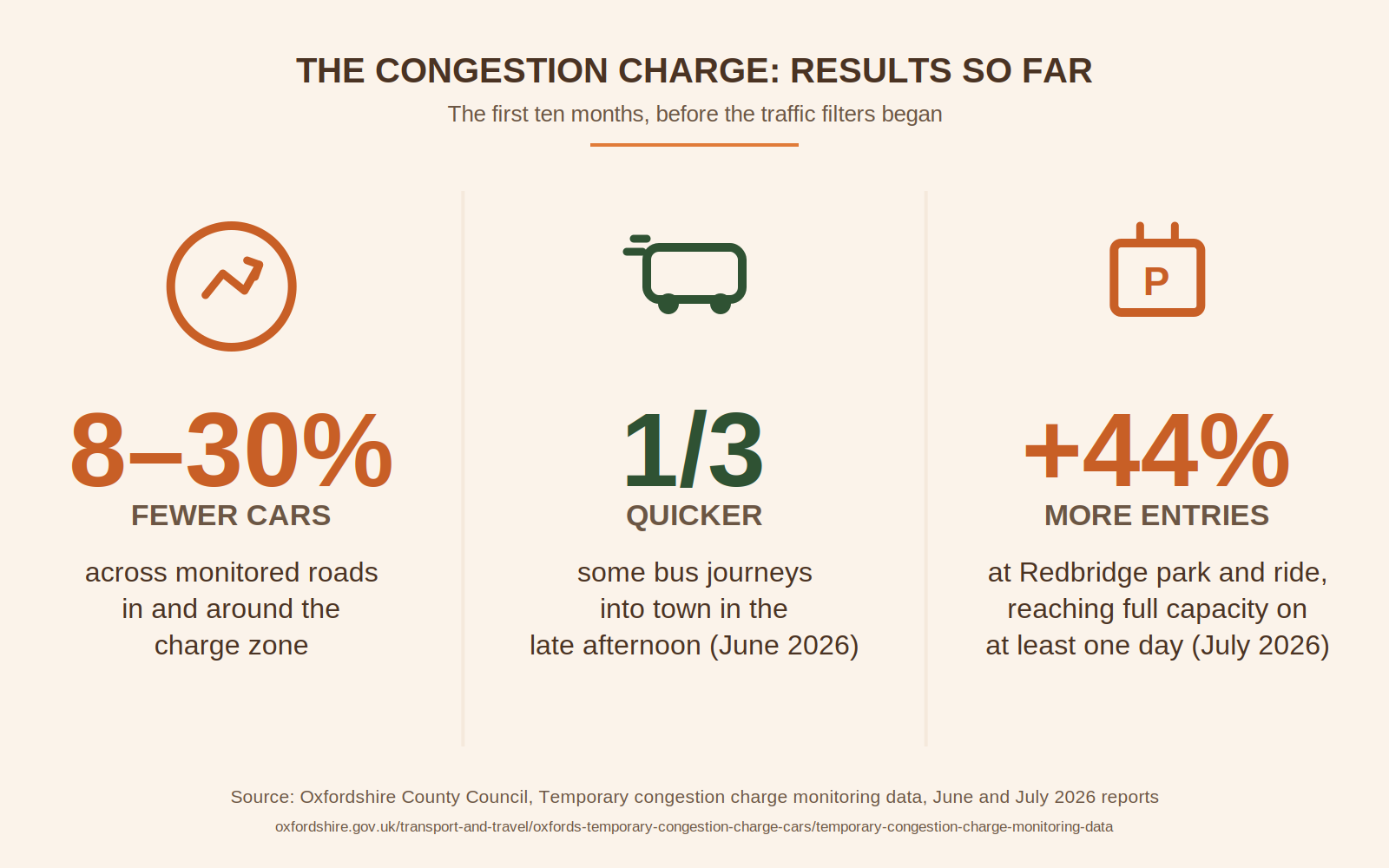
What this brief experiment on Congestion Charging has shown us is that the mechanism works in reducing traffic and congestion, improving bus services, and funding equity-led alternatives.
Traffic Filters: what does good look like?
With the Congestion Charge, we had plenty of real-world schemes and research to judge Oxford against. Before it launched, we already had a strong sense of what good looked like, from Stockholm, Gothenburg, London and elsewhere. Other cities don't get to decide what we think about Oxford, but knowing what has worked, and what hasn't, before a scheme lands is a useful starting point.
With the filters, that picture is much thinner. While we wait for the first real data, we've been down the rabbit hole looking for good comparative case studies, and come back largely empty-handed. Real-world evidence on filter-only schemes is limited.
Perhaps the closest we have is Ghent's Circulation Plan, introduced in 2017. It works on the same basic mechanism as Oxford's filters, camera enforcement rather than physical barriers (though some bollards and modal filtering on bus routes), no charge to pass, permits and exemptions for those who need them. It's also the model Oxfordshire's own filters plan has been compared to before, including by our colleagues at Headington Liveable Streets.
Ghent's results, by any measure, are striking. Car trips made by Ghent residents fell by 17%. Cycling in the city centre rose by more than half. Public transport use rose 6% overall, and 25% during the evening rush hour. The scheme cost around €6m to put in place.
But Ghent's plan is considerably more ambitious than Oxford's so, in this respect, perhaps unhelpful. It closes car traffic across entire sections of the city centre, not six filtered points, and it set out from the start to improve cycling, walking, public space and public realm together, not to manage traffic for the sake of bus reliability alone. This makes it a difficult like-for-like comparator, and Oxford can't expect success at this scale given the narrower scope. What it does give us however, is a potential model. I mean, come on – a car free Oxford City Centre?! (This might sound outlandish for some readers. Beyond the realms of possibility. But ask people what they want from their places, and you hear things like wide, tree-lined pavements, places to sit and gather, public squares where every generation feels welcome. There's a sort of longing for the European way of city living. No one asks for more traffic.)
Further, we couldn’t find anything specific on the redistributive effects of filtering from an equity perspective in Ghent, and as far as we know from our own light research, there’s no empirical evidence from a filtering scheme vs a charging scheme.
However, there’s plenty of theoretical arguments that support one of the biggest criticisms of the Oxford congestion charge – that it privileges those who can afford to pay. Vanoutrive and Zijlstra (2018, Transport Policy) argue directly against pricing. Their core point is that congestion pricing rests on willingness-to-pay, which is really ability to pay, and that structurally privileges wealthier drivers. They propose the alternative most relevant to filters: a needs-based rights approach, where access is allocated by what a trip requires (a carer visiting a client, a health worker on shift) rather than what someone can afford. That's close to how filters and their exemptions actually work in practice.
Monitoring effectiveness of the plan
So, what are we collectively watching for with the traffic filters? The OCC Monitoring Plan, agreed back in 2022, covers a broad sweep largely in line with what was being tracked for the Congestion Charge: traffic flows and displacement onto other roads, journey times for buses and general traffic, walking and cycling numbers, air quality, park and ride and rail use, business impact and footfall on the high street, road safety, and the experience of people with protected characteristics, including access to healthcare.
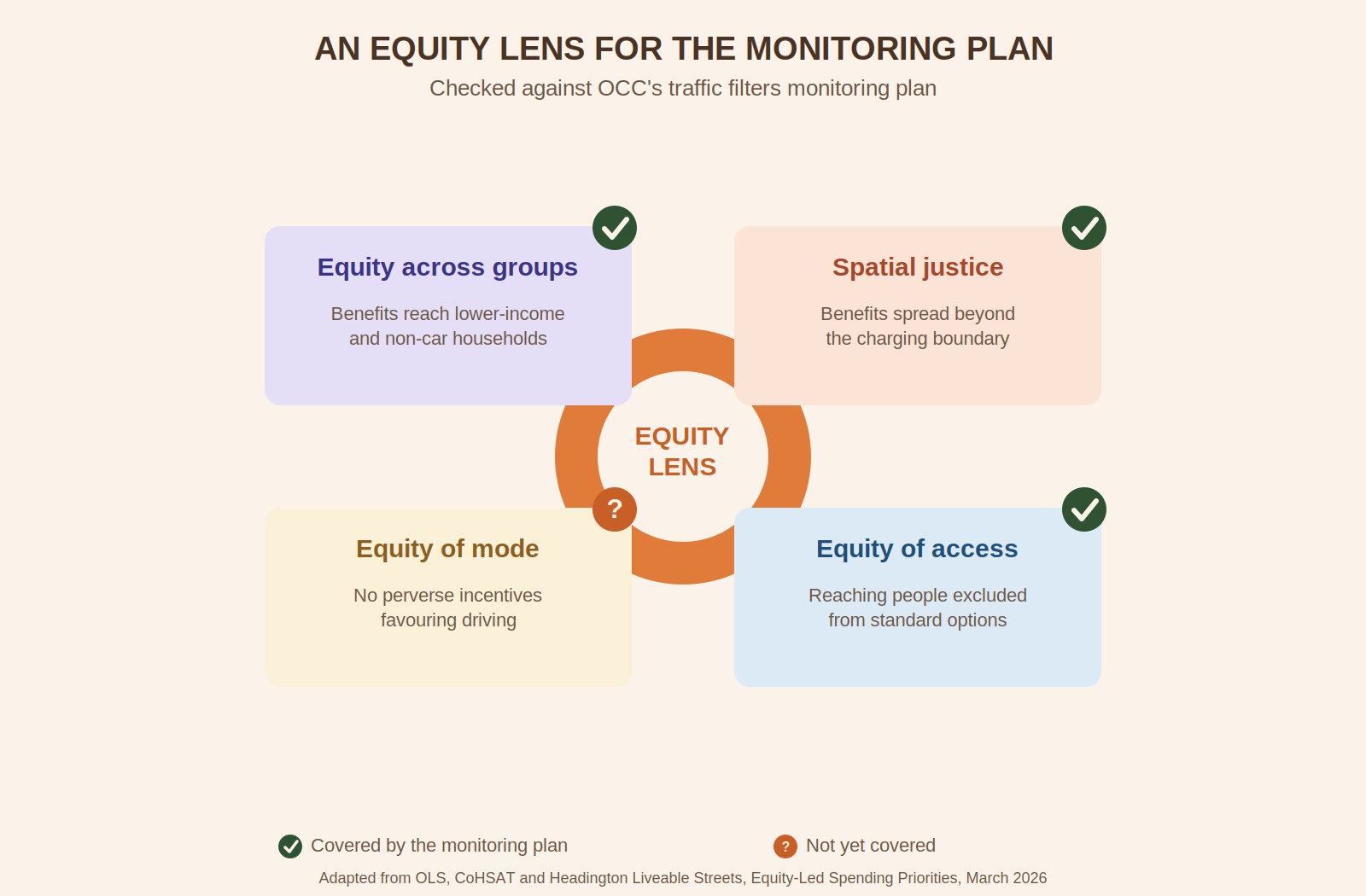
Set against our own four-part equity lens, it's a reasonably strong fit for three of the four. What's missing is any check on whether the way any surplus gets spent ends up unintentionally rewarding driving over the alternatives, our equity of mode question.
Less of a contest, more of a moment in time…?
It's tempting to treat this as a head-to-head, with the charge in one corner and the filters in the other, and wait to see who wins. But the more we dug, the less that framing held up. Both schemes are part of a longer journey. There WILL however come a moment, where Cabinet will need to make a call on where to next, based on the evidence laid before them.
Here are two provocations we're sitting with.
1. Could filters become regressive if they can't fund the carrot?
This is a real structural tension, and specific to Oxford given the Council's painfully low budgets for transport and infrastructure. The charge is a toll: people pay it and keep driving, so it keeps generating revenue. Filters are designed to produce compliance, not payment. Success looks like falling penalty income, which means the scheme raises the least money for buses, cycling routes and public realm at exactly the point it's working best.
So the fairer-by-design scheme carries a built-in risk. It restricts access more evenly, but if it can't fund the improvements that were meant to come with it, people who already rely on the bus are stuck with the bus as it is now, while the only people who feel the change are those who used to drive through. That's not regressive on day one, but it could become so slowly.
And for Oxford it's a live consideration. Some commitments in the Congestion Charge investment plan, like the hospital express and staff bus travel, run past 28 September.
What funds those once the charge stops and the surplus dries up?
2. Which scheme is best for where we are now in time?
The charge paid for its own success story: the money it raised bought the faster buses and new services that made the case for it. The filters won't have that advantage. Ghent's results came from a far bigger scheme with serious investment in alternatives alongside it, and six filters with no dedicated budget for alternatives is a very different proposition. So the filters could prove the better long-term option and still look weaker over an 18-month trial, simply because the carrot takes longer to arrive when the stick isn't paying for it.
That's why the comparison can only take us so far. Oxford was never choosing once between price and permit in the abstract.
“This is far from an ‘everything everywhere all at once’ intervention. Perhaps the better question is which mechanism, given where Oxford actually is right now (a relatively fragile bus network, existing patterns of car dependence, and a limited window of investment capacity), does the most good while the rest of that system matures around it?”
And this is far from an ‘everything everywhere all at once’ intervention. The Congestion Charge and the Traffic Filters are each one mechanism inside a wider proposed toolkit that includes the Zero Emission Zone, the Workplace Parking Levy, 20 mile per hour limits, bus improvements. Some of that toolkit is running now, some of it is still on its way, but none of these measures were ever meant to do the job alone.
So perhaps the better question isn't which lever builds the fairer Oxford in principle. It's which mechanism, given where Oxford actually is right now (a relatively fragile bus network, existing patterns of car dependence, and a limited window of investment capacity), does the most good while the rest of that system matures around it?
We're going to finish on a final provocation, one bigger than charges and filters. The job of shifting Oxfordshire away from car dependency was never going to be one department in one council alone. A car-first way of thinking, and all the harms that come with it, has become so normal we barely notice it. Civil society groups, residents, businesses and communities all have a part to play. This is exactly what the next stage of Future Streets Oxfordshire will be asking. Now we know what people want from their streets, what will it take to get us there?
Further reading:
- For those curious about the Ghent Circulation Plan, this Headington Liveable Streets blog post from 2024 looked at Ghent as a potential blue-print for Oxford.
- If you want to get underneath the bigger question of why traffic filters, head to our dedicated microsite on traffic filters, written and built by OLS back in 2024 to explain why Oxford was in desperate need of traffic management to reduce congestion.
- Head to the Oxfordshire County Council Traffic Filters page for the key details on where the filters are, passes, and fines etc.
- OLS has dedicated traffic filters pages too including FAQs.
- The Oxford Travel Options website is great for exploring different ways to get in and around the city.
- The Oxford Park and Ride page is also really helpful.